
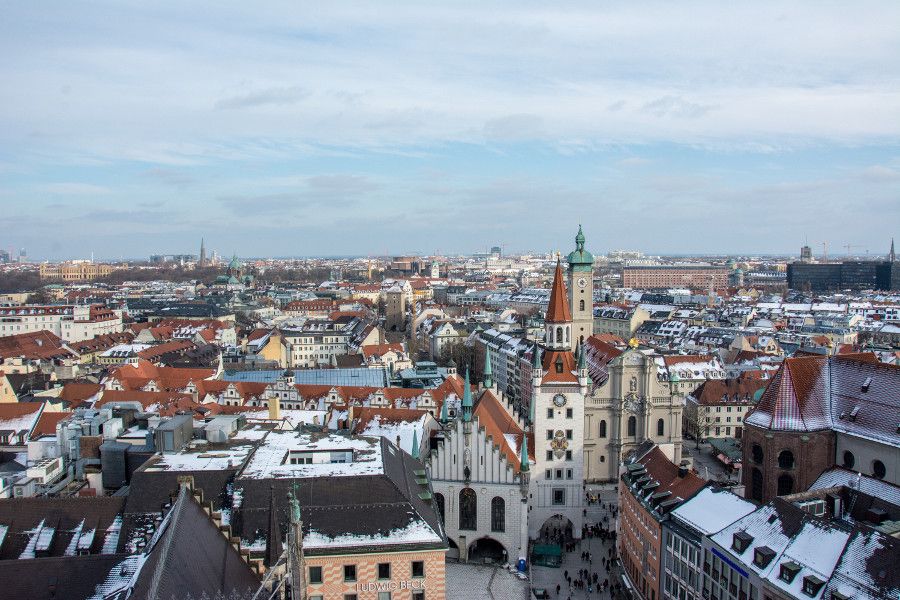
Munich is famous for many things, but being affordable isn’t one of them. The Bavarian capital is in high demand, which often means higher prices.
The good news? Munich offers dozens of parks, landmarks, markets, and cultural sights that are completely free, making it possible to explore the city on a budget—especially for first-time visitors. Many of these attractions cluster along the Isar, in Altstadt, and near Englischer Garten, making them easy to group into free walking days without relying on transit.
Updated for 2026, this guide covers 29 fun free things to do in Munich, including parks, landmarks, museums, markets, and seasonal festivals.
This guide is perfect for:
- First-time visitors
- Budget travelers
- Students & solo travelers
- Travelers padding paid attractions with free sights
Many attractions in Munich are free to explore from the outside, with optional paid interiors for those who want to go deeper.
Table of Contents
Parks & Nature
Stroll Through Hirschgarten, Munich’s Local Park in the West
A cozy spot in western Munich, Hirschgarten isn’t just home to the largest Biergarten in the world. It also functions as a true neighborhood park. With athletic fields, ping pong tables, a skate park, and playgrounds, there is something for everyone at this truly family-oriented spot. You’ll often see commuters cutting through the park or families with small children getting some fresh air. You can even visit with a herd of deer (or Hirsch in German) that live in a fenced-in spot near the restaurant.
Why locals love it: A neighborhood park that feels lived-in, not touristy.
Walk the Nymphenburg Palace Canals for a Peaceful Free Stroll
Extending out east from Schloss Nymphenburg and running throughout the castle estate is a canal system. The canals are shallow and, in winter, often freeze over and are a popular place for enjoying ice skating, ice hockey, and frozen winter sports. The canal paths are a pleasant place for a stroll in any season. Trees and residences line the path.
For a deeper visit, including what’s free versus ticketed, see my complete Nymphenburg Palace & Park guide.
Best for a quiet walk: Especially lovely in winter or early morning.
Watch the Eisbach Surfers in Munich’s Englischer Garten
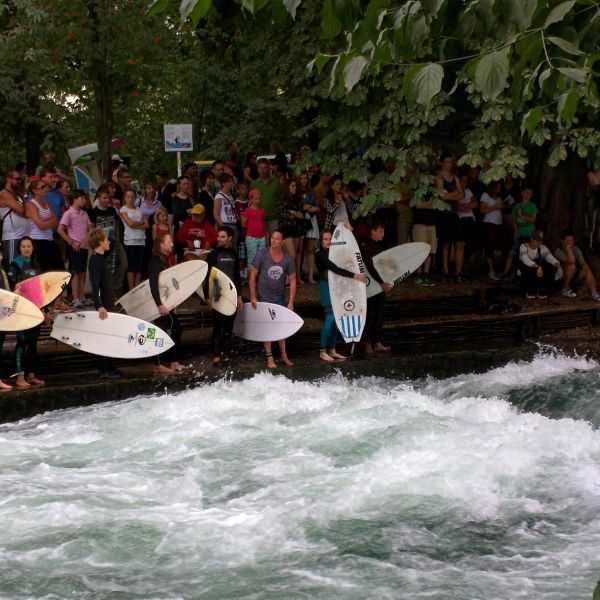
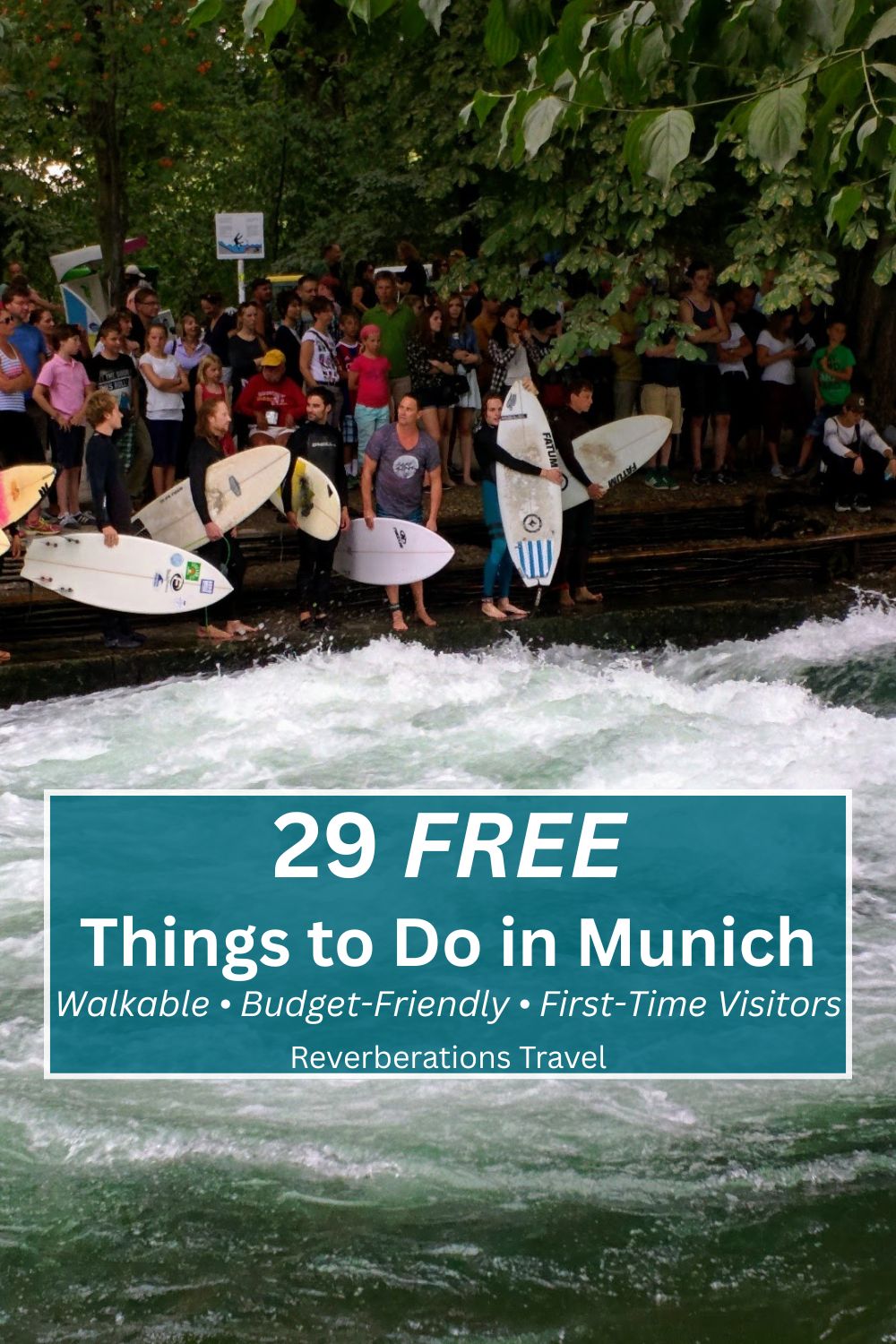
Visitors and locals alike flock to the Englischer Garten to rest, relax, and unwind in the park or at one of the park’s several Biergarten. But on the southern edge near the Bavarian National Museum, spectators line the bridge and banks of the Eisbach to watch surfers, one of the most popular free things to do in Munich.
Yes—deep in Bavaria, within sight of the Alps, there’s an outdoor surfing oasis. A quirk in how the Eisbach flows over submerged rocks creates a rideable wave day and night. Year-round surfers don wetsuits, boards under their arms, and wait their turn in the wave.
As of late 2025, cleanup work has made the wave slightly less consistent. As such, there’s a minor possibility that there may not be surfing when you visit. Even when surfing pauses, the Eisbach area remains a popular free stop for walking and people-watching.
A Munich classic: Urban surfing you can watch year-round, for free.
Explore Olympiapark, Munich’s Former Olympic Grounds
Munich famously hosted the 1972 Summer Olympics, and visitors can still enjoy the Olympic Park built for the Games. From the Olympicturm, or Olympic Tower, which can be spotted from a distance, to the architecturally unique Olympic stadium, there’s much to see at the Olympiapark. The park is free; attractions are ticketed. When you tire of sightseeing, the park itself is a pleasant place to slow down and enjoy the view.
Legacy of the 1972 Olympics: A mix of architecture, views, and green space.
Relax in Englischer Garten, One of the World’s Largest Urban Parks
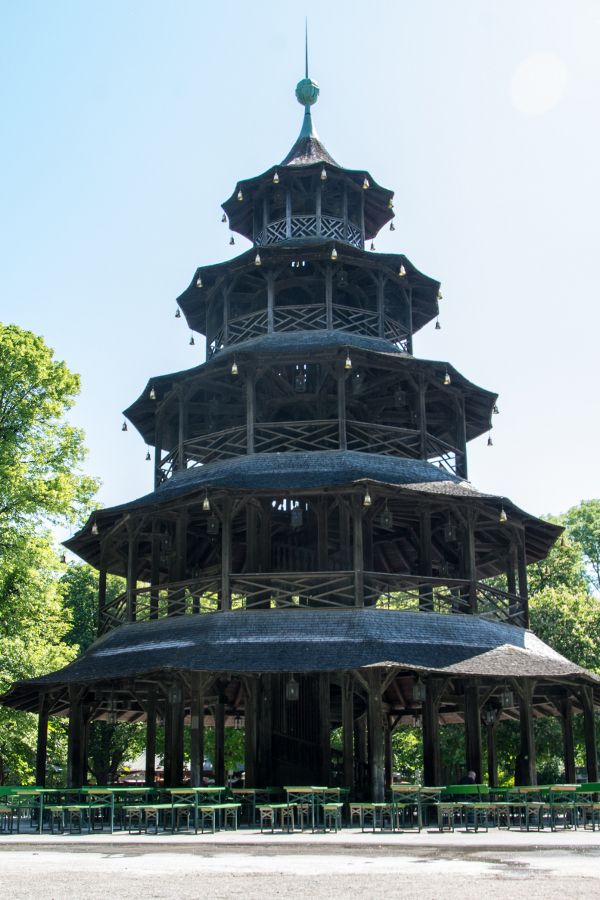
Englischer Garten is the backyard of Munich’s residents. It’s one of the world’s largest urban parks, beating out even Central Park. Its sheer size can make it feel overwhelming at first. The meandering paths can be confusing at times. Whether you’re looking for sports or leisure, Englischer Garten has a spot or a bench for you. The park’s Chinesischer Turm is a popular landmark and attraction. It’s consistently one of the most popular free things to do in Munich.
Munich’s backyard: Bigger than Central Park and just as beloved.
Visit the Old Botanical Garden in Maxvorstadt
While the city’s Botanical Garden that sits beside Schloss Nymphenburg is a beautiful spot and a great way to spend a day, it does have an admission fee. But from 1812 until 1914, the city’s botanical garden sat in Maxvorstadt just a couple of blocks north of Karlsplatz.
Now known as the Old Botanical Garden, it’s still worth visiting and serves as a small park. A large water fountain featuring Neptune is a central focal point of the park and the surrounding garden. The park is still home to several exotic tree species. It’s a quiet reminder of the garden’s past and one of Munich’s most relaxing free stops.
A hidden pocket of calm: Easy to miss, but worth slowing down for.
Walk Along the Isar River Through Central Munich
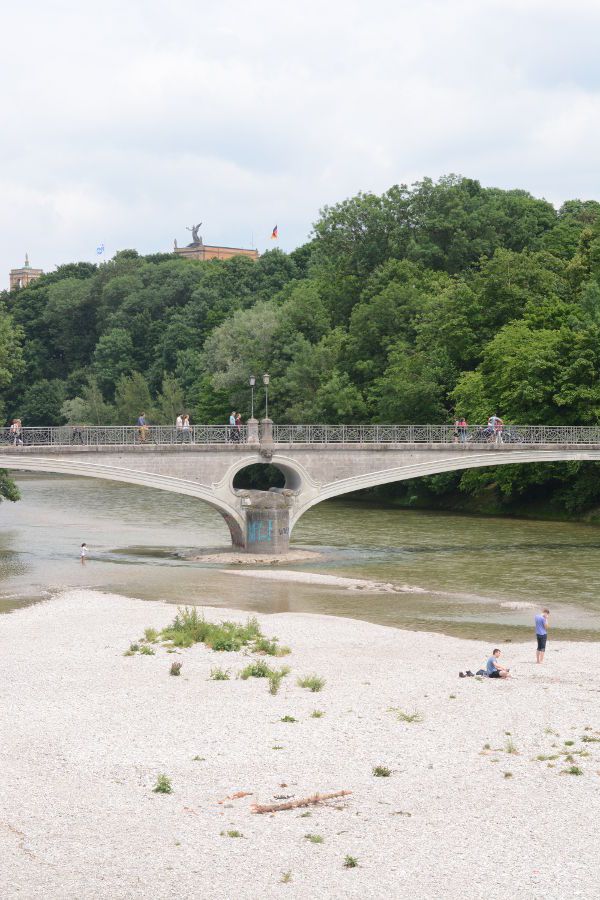
The Isar River is much loved in Munich. Locals can often be found relaxing on its stone beaches along the river’s edge. Both sides of the river are lined with greenery and trees. Park trails for walking, jogging, and exploring run along the border area on both sides. Maximiliansanlagen is the largest such park, encompassing both the Maximilianeum and the Friedensengel. On the western side of the river, the path is narrower but runs right along the Isar. The river marks the transition between city life and nature.
Where city meets nature: One of Munich’s favorite outdoor gathering spots.
Architecture & Landmarks
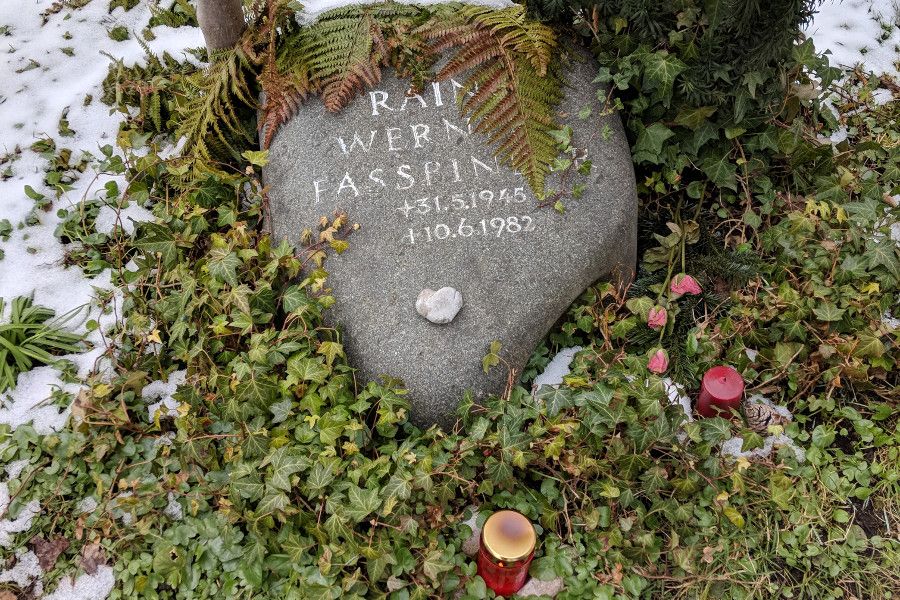
Visit Bogenhausen Cemetery, a Quiet Historic Spot in Munich
Just a quick walk from the Englischer Garten and across the Max-Joseph-Brücke is the Bogenhauser Friedhof, or cemetery. This historic cemetery is a popular resting place for famous Germans. Visitors can pay their respects at the graves of filmmakers Rainer Werner Fassbinder and Helmut Dietl, film producer Bernd Eichinger, and author Oskar Maria Graf, among others. Each grave is very individualized, and there are many lovely plants. It’s a very peaceful spot and definitely Munich off the beaten path, especially for foreign tourists.
Off the beaten path: Peaceful, reflective, and rarely crowded.
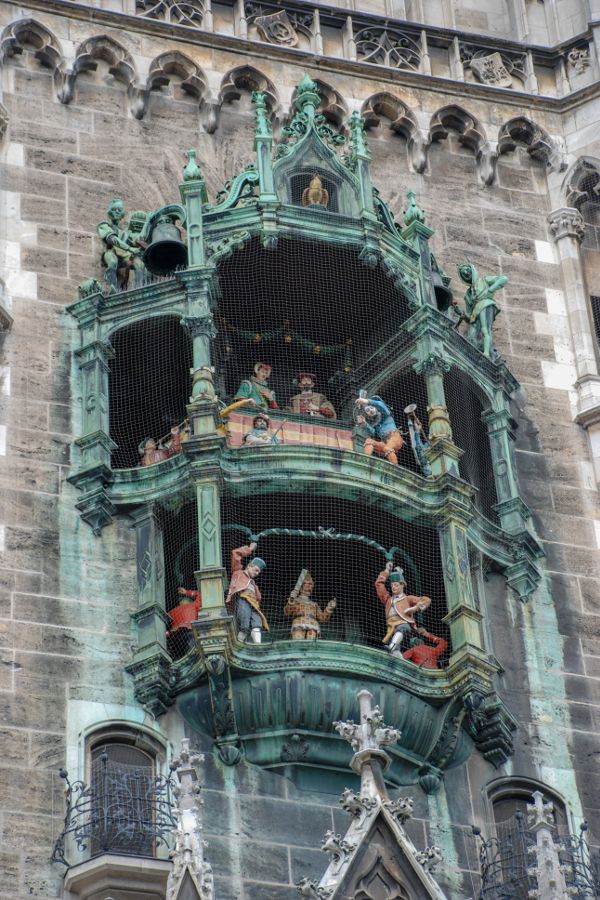
Watch the Glockenspiel at Marienplatz
Every day of the week, visitors to Munich pack into Marienplatz to watch the Neues Rathaus Glockenspiel perform. With cameras and phones out and snapping away, the Glockenspiel enthralls watchers. Dating to 1908, the mechanism spins, showing knights jousting and coopers dancing as the clock bells chime.
It’s a charming tradition, especially in today’s fast-paced digital life, that every visitor to Munich should see at least once. As of 2026, the performance is daily at 11 am and at noon. From March to October, there’s a second show at 5 pm.
And there’s a bonus! What many don’t know is that at 9 pm, there’s a different performance where the nightwatchman blows his horn as the Münchner Kindl, or Munich child, goes to bed.
A must-see classic: Touristy, yes — but charming for a reason.
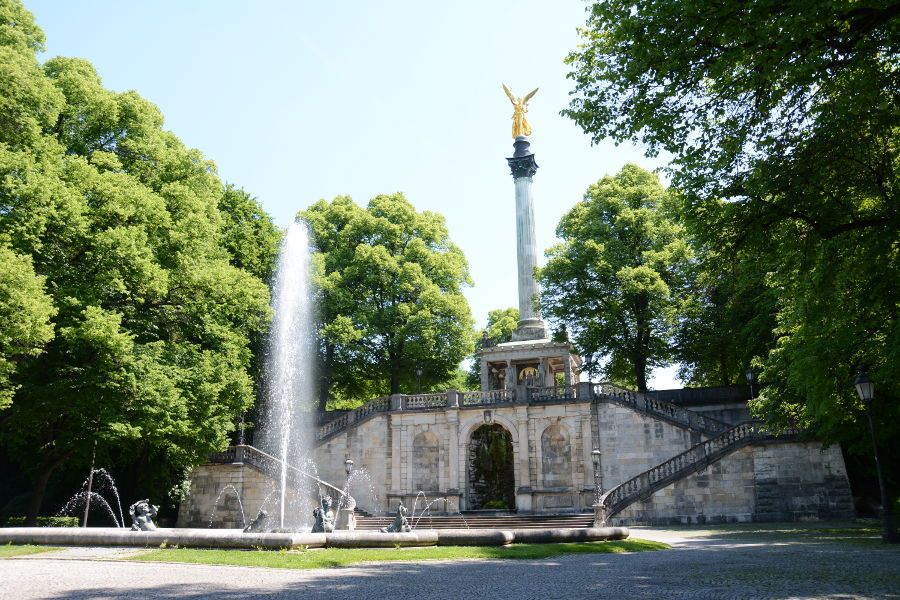
See the Friedensengel and Putti Fountain Above the Isar
The golden angel standing atop a column on Prinzregentenstrasse is a popular landmark and worth visiting. From her perch overlooking the city and the Isar, the Friedensengel (or Angel of Peace) has a large fountain before her. Called the Putti Fountain, it is the work of Munich-based sculptor Wilhelm von Rümann. From there are a series of stairs leading up to an observation area at the base of the column.
The Friedensengel isn’t just decorative; it’s commemorative. Dating back to 1896, the Friedensengel commemorates the quarter-century of peace following the Franco-German War. The angel is the work of Heinrich Düll, Georg Pezold, and Mark Heilmaier.
The six-meter-tall gilded bronze angel depicts Nike of Paionios. She stands, arm outstretched, on a 38-meter-high column. Beneath the column sits a mosaic-covered temple with additional statues. It pays tribute to German and Bavarian emperors, rulers, and generals.
Admire Historic Architecture in Munich’s Haidhausen District (Free Walking Area)
No one could ever accuse Munich of being an unattractive city. Simply everywhere you look, there are beautiful buildings with that special Bavarian charm. But the city’s Haidhausen district is not only trendy but also very beautiful. Wiener Platz is perhaps the most remarkable, with historic buildings surrounding the square, which hosts a market. A maypole stands proudly in the center of the cobblestone square for a little extra reminder that this is, indeed, Bavaria.
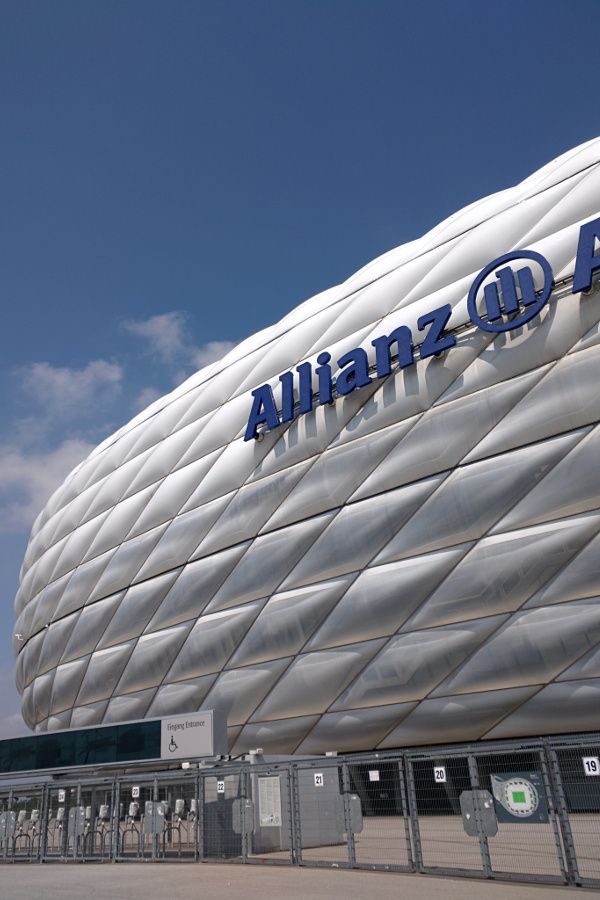
See the Allianz Arena, Home of FC Bayern Munich
The world-famous Allianz Arena opened in 2005 and has since been the home of FC Bayern München. The stadium seats 75,000! It’s free to visit and admire the stadium from the outside. Even if you’re not attending a match, the Allianz Arena is one of Munich’s most recognizable modern landmarks. Designed by architects Herzog & de Meuron, the exterior is constructed with inflated ETFE plastic panels. At night, the panels are lit up. If Bayern has a game, you’ll find them to be red. If the stadium is hosting the German national team, it’ll be white. During the holidays, it adopts a more fun lighting scheme. St. Patrick’s Day sees the Allianz Arena go green, while also mimicking the American flag.
Iconic from the outside: You don’t need a ticket to appreciate the design.
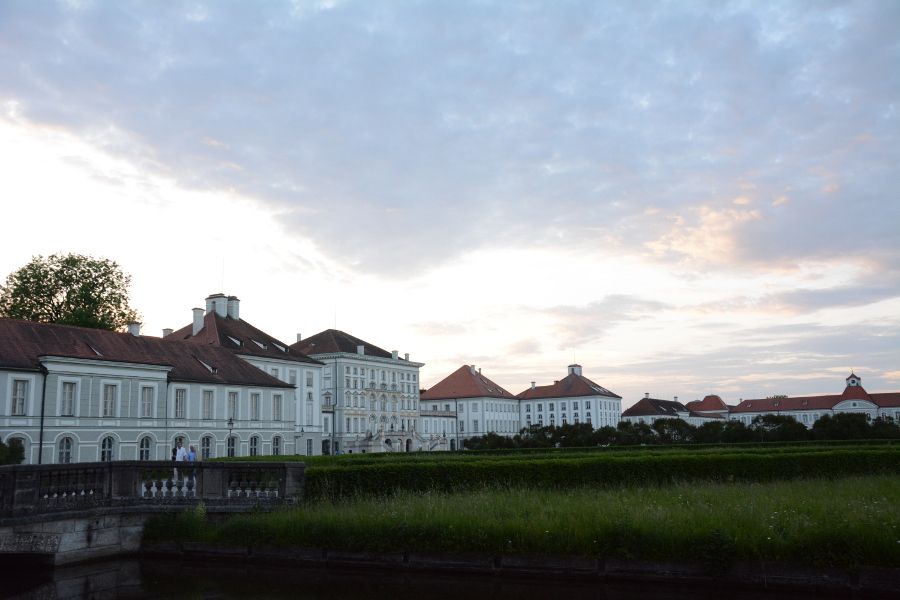
Explore Nymphenburg Palace Park and Gardens for Free
On the western edge of Munich lies Schloss Nymphenburg. The beautiful palace was home to countless royals and is the birthplace of King Ludwig II. Manicured gardens, canals, and ponds surround the palace, and small palace buildings dot the property. The palace grounds and park are free year-round, but to see the palace interior and the small park buildings requires paid admission. Miles of paths wind through the grounds and into more wooded terrain. You might even see a deer sneaking through the woods.
The westernmost part of the park is where you’re more likely to ditch the tourists and find the locals out for a stroll: exercising or catching up with friends. A favorite spot of mine is the pond right outside the Badenburg building. Grab one of the benches or sit at the temple Monopteros to watch the swans, ducks, and other birds in their natural habitat. Nymphenburg remains one of my favorite free places in Munich.
Local tip: The western paths of Nymphenburg Park are quieter and more popular with locals, especially in the evening.
Free year-round: The grounds are just as rewarding as the palace interior.
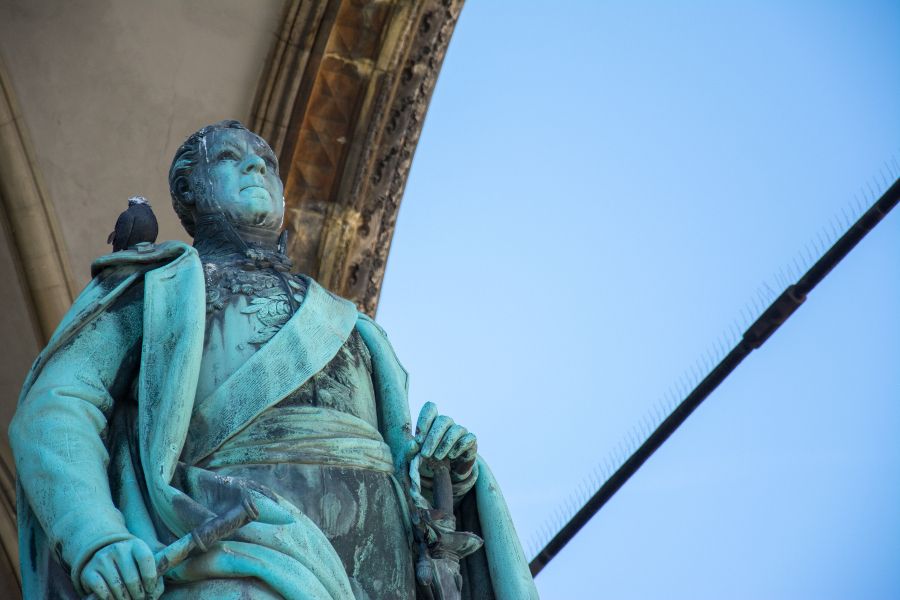
Visit Odeonsplatz and the Historic Feldherrnhalle
On the one hand, Odeonsplatz is an urban square just north of Marienplatz with international inspiration. The square itself draws on Rome’s Palazzo Farnese. The Feldherrnhalle monument, on the square’s southern edge, is modeled after Florence’s Loggia dei Lanzi. It’s no wonder that Munich is often referred to as Italy’s northernmost city. It offers a visual break from the dense streets of the Altstadt.
But, like so much of Munich, Odeonsplatz is steeped in history. During the Beer Hall Putsch in 1923, Adolf Hitler (then leader of the National Socialist German Workers’ Party) and others tried to grab power. The coup ended in a shootout with police in Odeonsplatz at Feldherrnhalle. Four Bavarian police officers were killed along with sixteen Nazis. Today, plaques remember the police officers at the site.
Beautiful and complex: One of Munich’s most layered historic spaces.
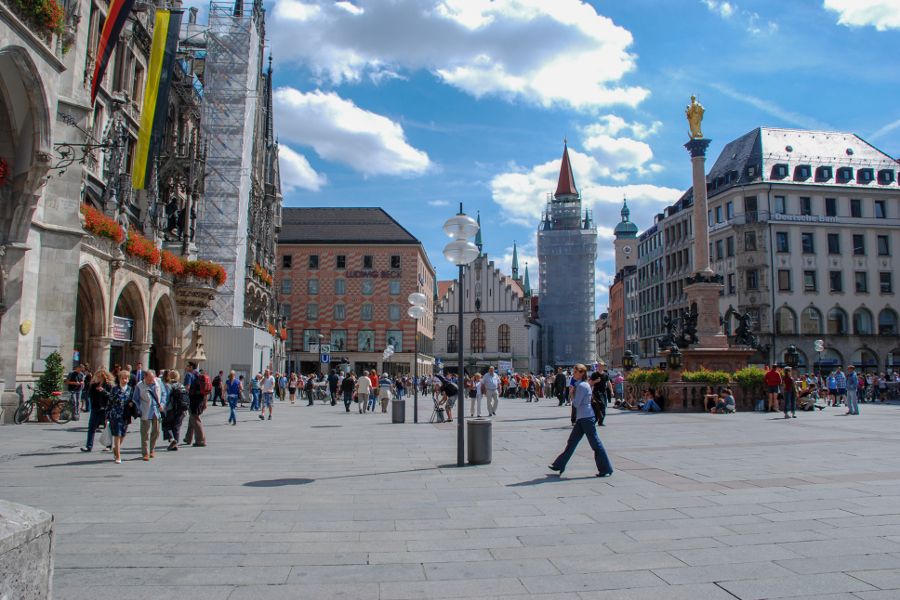
Explore Marienplatz, the Heart of Munich’s Old Town
With its massive neo-Gothic town hall, its more moderate but colorful late-Gothic town hall, and the Glockenspiel, Marienplatz is quite literally the heartbeat of Munich’s Altstadt. It’s difficult to envisage a visit to Munich that doesn’t include a visit to Marienplatz — even if that means cutting through the square on your way to somewhere else.
The square is richly decorated with plenty of buildings, statues, and fountains to explore up close. Marienplatz is a landmark for a reason. Be sure to wander into the courtyard of the Neues Rathaus for even more architectural beauty. The gargoyle rain spouts are a favorite of mine!
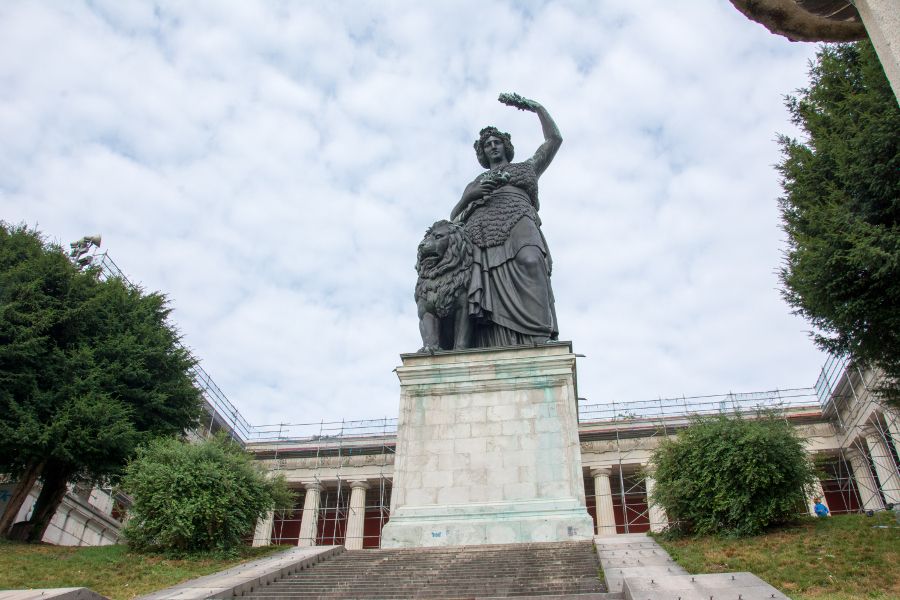
Visit the Bavaria Statue and Ruhmeshalle at Theresienwiese
The lady Bavaria stands strongly, confidently on the western edge of the famous Theresienwiese. She has her arm outstretched overhead with a wreath in hand, while at her feet sits a lion loyally. Behind Bavaria is a 19th-century pantheon, the Hall of Fame (Ruhmeshalle), that contains busts of notable Bavarians.
The open-air Hall of Fame is free to explore, where you can see the busts up close and get an impressive view over the Wiesn, the grounds that host so many of Munich’s events throughout the year, with Oktoberfest undoubtedly being the most famous.
The Bavaria statue itself is actually a tower, with a tight spiral staircase inside leading to a view out of peepholes in her head. While the tower costs a fee, it’s free to admire the beautiful artwork and casting from the outside.
Wander Through Viktualienmarkt, Munich’s Famous Open-Air Market
Just off of Marienplatz sits Munich’s famous open-air market. Since 1807, Viktualienmarkt has served shoppers daily, and it’s easy to see why. Take a visit to Viktualienmarkt to stroll between the stalls selling fresh fruits, vegetables, meat, and other foods, as well as crafts, flowers, and more. In true Bavarian style, there’s even a Biergarten. The beer on tap changes daily, rotating between the local breweries. Viktualienmarkt is a real mix of locals and tourists alike.
More than a market: A snapshot of daily life in the city center.
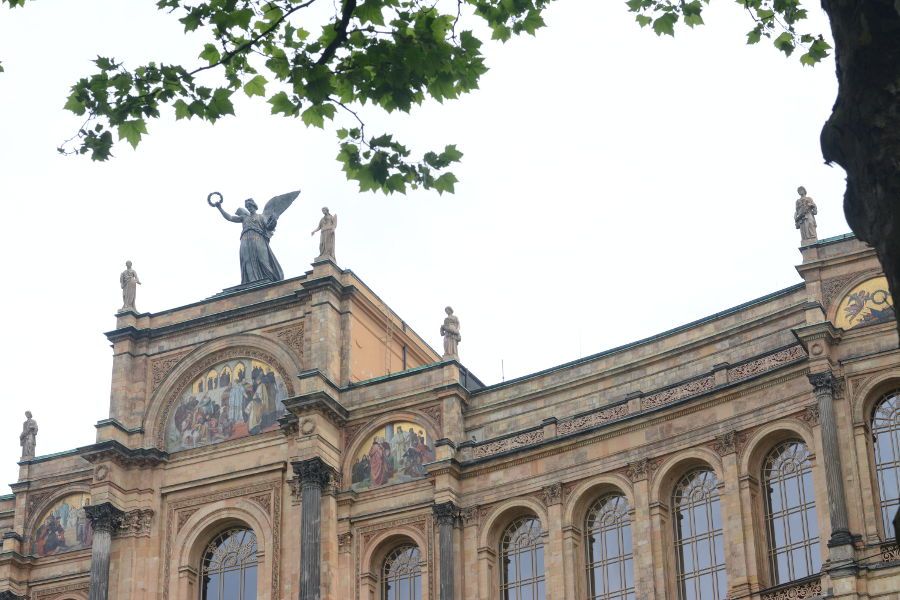
Admire the Maximilianeum, Seat of Bavaria’s Parliament
The building on the hill, the Maximilianeum was to be the home of a gifted students’ foundation. Today, it serves as the Bavarian state parliament building (Bayerischer Landtag).
Construction on the building began in 1857 under King Maximilian II of Bavaria. It was completed in 1874. The original design, led by architect Friedrich Bürklein, was to be of neo-Gothic style, much like other buildings along Maximilianstrasse. The plan changed, however, to more of a Renaissance design under Gottfried Semper. The massive and impressive building has large windows that shimmer in the light. And it has many niches and alcoves in which sit busts, statues, and other lavish decorations.
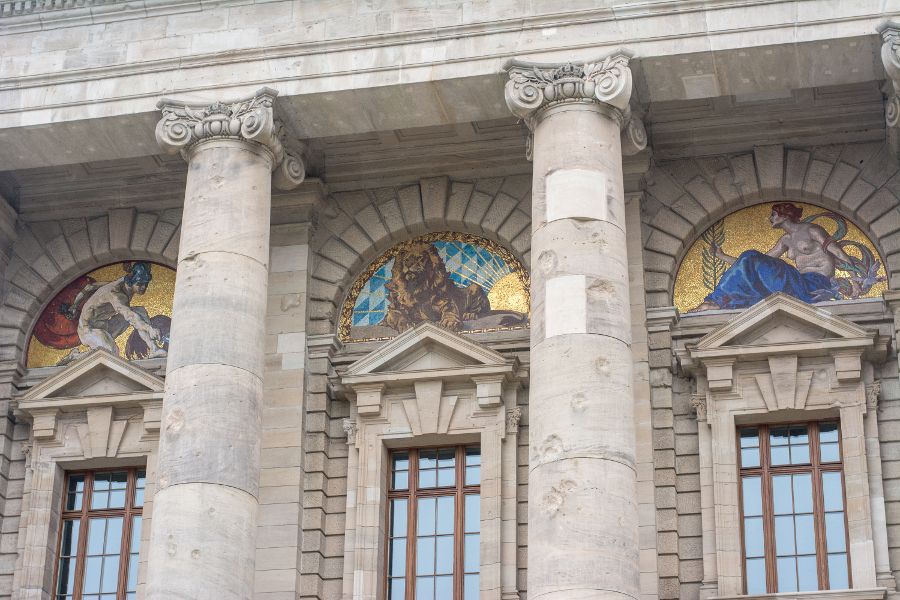
Explore the Bayerische Staatskanzlei Near the Hofgarten
Just off to the side of the lovely Hofgarten, with its Diana temple and crisscrossing flower garden, sits the Bavarian Chancellery behind a row of trees that obscures the view. The Bayerische Staatskanzlei, like much of Munich, is a blending of old and new. But unlike much of Munich, which was rebuilt to its pre-World War II status, the Staatskanzlei uses the commanding former Bavarian army museum building from 1905 with a striking addition from the late 1980s/early 1990s that sees wings of curved glass extending from either side of the original dome and columns.
Just before the building is a unique war memorial that was originally intended to honor the 13,000 soldiers from Munich who were lost during World War I. Located below ground level, visitors ascend flights of stairs and enter an open-air but covered pavilion that contains a sarcophagus with the remains of a soldier. Designed by sculptor Karl Knappe and architects Thomas Wechs and Eberhard Finsterwalder, the sobering memorial was dedicated in 1924 before being completed in 1928.
After World War II, as the city was rebuilding, the memorial was also rebuilt and updated to memorialize the tens of thousands of Munichers who were killed in action, missing in action, or victims of air raids.
Museums & Culture
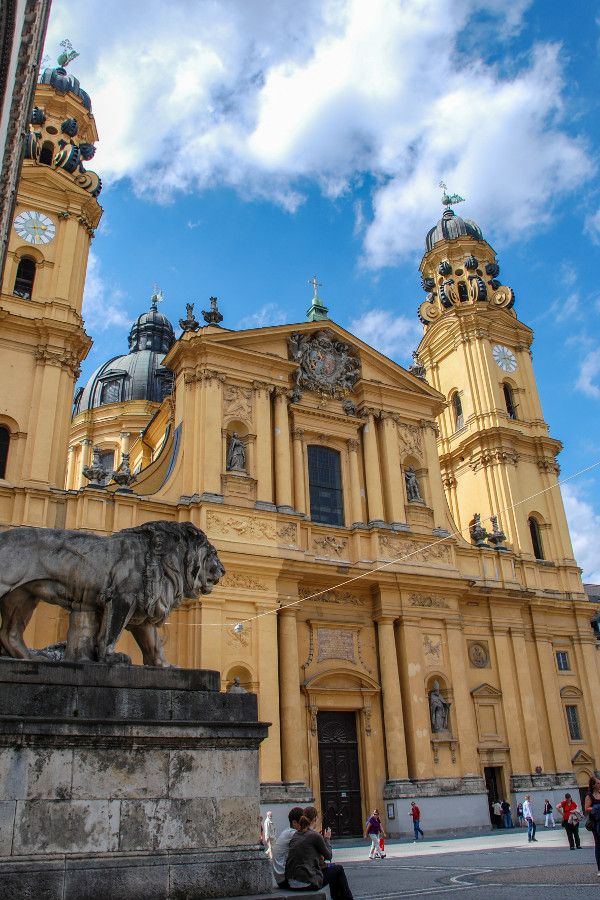
Visit Munich’s Churches for Architecture and Quiet Reflection
Munich’s churches are a popular spot and not just for the pious. Beautiful architecture, art, and history await visitors inside the churches. The Frauenkirche is, without a doubt, Munich’s most iconic church. Maybe it is even its most iconic building. The church’s twin towers with their green-domed roofs are an important part of the city’s skyline. In fact, to this day, buildings may not exceed the height of the Frauenkirche. And the award for the city’s most lavish and elaborate church goes to the Asamkirche. All of the city’s churches are worth a visit, whether it’s for reflection or sightseeing.
Visit Schloss Blutenburg, a Lesser-Known Castle Near Munich (Grounds Free)
Just west of Schloss Nymphenburg, less than three miles on foot, lies the often overlooked Schloss Blutenburg. Complete with a moat, the original castle served as a hunting lodge for Duke Albert III in the 15th century. Due to fire, war, and abandonment over the centuries, the castle has been built and rebuilt. Also on the site is the palace chapel.
Today, the castle houses an international youth library. But the chapel and the grounds are open to the public and can be visited at no cost.
Visit Free Museums in Munich (and €1 Sundays)
While most museums in Munich charge admission, several museums are completely free to visit year-round. Or, if your schedule is flexible, visit on a Sunday when many museums charge only 1 Euro for admission.
It’s an easy way to support local institutions while expanding your own knowledge.
Budget-friendly culture: Mix always-free museums with €1 Sundays.
Here are completely free museums in Munich:
- Munich Documentation Center for the History of National Socialism
- Palaeontological Museum Munich
- Geological Museum Munich
- Bavarian State Library
- Lothringer13 Halle
- MaximiliansForum
- Münchner Kaiserburg
- Museum für Abgüsse Klassischer Bildwerke München (Museum for Castings of Classical Sculptures)
- Rathausgalerie (City Hall Gallery)
- Botanical Garden Munich-Nymphenburg – free only in winter
- AMuseum of Contemporary Art
- Kunstarkaden
Stroll the Grounds of Schloss Schleißheim Near Munich
Less than an hour north of Munich and right off the S-Bahn line near the airport sits Schloss Schleißheim. There, visitors can find three massive and magnificent baroque palaces surrounded by formal gardens and a lovely park. Palace interiors require a ticket, but the park and grounds are free. Go for a visit just to stroll the property, enjoy a wonderful day out, and take in the view of Munich.
Watch FC Bayern Train at a Public Practice Session
Getting your hands on tickets for an FC Bayern Munich game can be difficult and expensive. But instead of watching the team play a game in the Allianz Arena with more than 60,000 other people, why not attend a public practice session?
FC Bayern regularly holds training sessions that are open to the public at its Säbener Strasse facility. Public training schedules can change seasonally — check the club’s official site before visiting. Not only will you get to see the stars training, but some of the players may also even sign autographs or take photos with fans.
For football fans: A rare chance to see the stars up close.
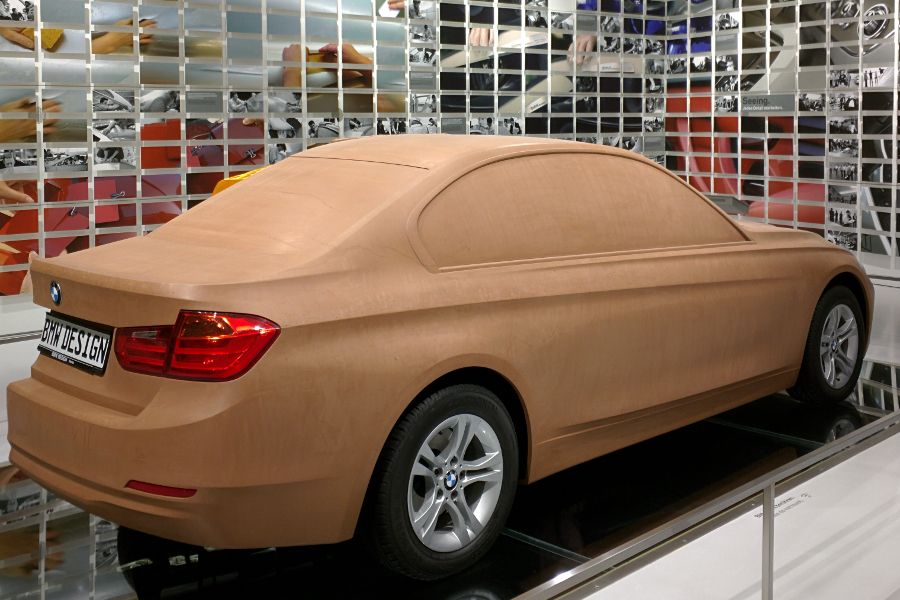
Visit BMW Welt, a Free Exhibition Next to Olympiapark
BMW’s headquarters is perhaps Munich’s most unique building. It resembles the 4-cylinders of a car engine, while the adjacent museum is a cylinder head. And right next door to HQ and the museum, on the edge of Olympiapark, is BMW Welt, or BMW World.
BMW Welt’s showroom and exhibition space is free year-round. Gearheads can get a close-up look at some of the iconic brand’s newest and most popular cars and motorcycles. You can sit in select models, get photos, and indulge in a bit of automotive fantasy.
Go Window Shopping on Munich’s Most Famous Streets (for Free)
From designer brands with international name recognition to carefully handcrafted artisan items, Munich has a shopping street to appeal to everyone. And sometimes window shopping teaches you a lot about a place. Along Maximilianstr. you’ll find some of the city’s most luxurious and expensive shops. Extending west from Marienplatz, the pedestrian-only Kaufingerstr. is more affordable as well as more touristy. Along Sendlinger Str. you’ll find more independent shops.
But my favorite are the Tracht shops selling well-made traditional clothing like Dirndls and Lederhosen. The prettiest outfits are almost always the most expensive!
Markets & Festivals
Attend Free Music Festivals in Munich
Munich is alive with the sound of music, and that includes free music festivals throughout the year. Opera For All offers a free open-air concert and a free opera live broadcast from the Nationaltheater.
There’s also the 24-day-long summer festival Theatron that features music of a variety of genres and is the world’s longest music festival.
Experience Munich’s Seasonal Festivals for Free
Throughout the year, Munich hosts some great festivals and events. In the late summer, there’s Oktoberfest, in early spring there’s Frühlingsfest, plus there are flea markets and many other seasonal Munich beer festivals. (Getting hassled by a Krampus in December and visiting the Christmas markets is on my bucket list, to be sure!)
Generally, there is no admission charge for the festivals. You’re free to attend and enjoy the atmosphere. Food, drink, and (if there are any) carnival games and rides will be pay-as-you-go. You stay fully in control of how much you spend. The city’s festivals are one of the fun free things to do in Munich to experience some of the local culture.
Festival schedules vary by season, making this one of the best free activities to pair with a longer Munich stay.
Pay only for what you eat or drink: Entry is usually free.
Plan Your Trip
These guides pair well with a free-focused itinerary and help you decide where paid attractions are worth it.
- Munich Travel Guide
- Nymphenburg Palace & Park Guide
- Sightseeing Guide to Munich’s Churches
- Biergarten guide
- Bavaria budget travel
Frequently Asked Questions About Free Things to Do in Munich
Below are quick answers to the most common questions travelers ask when planning a budget-friendly trip to Munich.
Is Munich expensive to visit?
Munich has a reputation for being expensive, especially when it comes to accommodation and dining. However, many of the city’s parks, landmarks, markets, churches, and cultural sights are completely free to visit, making it possible to enjoy Munich on a budget.
Are there free things to do in Munich year-round?
Yes. Many of Munich’s best free activities — such as walking through Englischer Garten, exploring Marienplatz, strolling along the Isar River, and visiting open-air markets — are available year-round. Seasonal events and festivals also offer free entry throughout the year.
Are museums free in Munich?
Some museums in Munich are always free, while many others offer discounted admission on Sundays, when entry costs just 1 euro. A handful of museums, such as the NS Documentation Center and several small galleries, can be visited free of charge on any day.
What can you do for free in Munich on Sundays?
Sundays are a great time to visit museums with reduced admission, attend festivals, explore parks, and wander markets like Viktualienmarkt. Many locals also spend Sundays relaxing along the Isar River or in Englischer Garten.
Is Nymphenburg Palace free to visit?
The interior of Nymphenburg Palace requires a ticket, but the expansive palace park and grounds are free to enter. Visitors can walk the canals, gardens, and wooded paths without paying an admission fee.
Can you really watch surfers in Munich for free?
Yes. Spectators can watch surfers ride the Eisbach wave in the Englischer Garten year-round at no cost. Surfing conditions can vary depending on water flow and maintenance, so activity may occasionally be limited.
Are Munich’s festivals free to attend?
Most festivals in Munich, including Oktoberfest and Frühlingsfest, as well as many seasonal events, do not charge an entry fee. Food, drinks, rides, and activities are typically pay-as-you-go.
If you’re planning a longer stay in Munich, pair these free attractions with my complete Munich Travel Guide to plan walkable days, budget-friendly neighborhoods, and paid highlights worth the splurge or tips for saving money while traveling in Bavaria to build an itinerary that balances highlights with budget-friendly experiences.
Save this post for later with Pinterest!

All photos and opinions are my own.


