
No one wants to overspend when they travel, and Munich is known as one of Germany‘s most expensive cities. With city passes, visitors can theoretically save some money by bundling attractions into a single ticket.
The city offers two official passes: the Munich Card (which offers discounts on entry fees and shopping at 100+ locations) and the Munich City Pass (which offers free entry to 45 attractions and tours). Both offer the option of free public transit. But which to choose? (If either!)
With this guide, I’m breaking down for 2025 the current prices, the attractions included, and a simple calculator to determine if it’s worth getting one of these passes based on your travel interests and style.
The prices and attractions mentioned in this post are current as of December 2025.
Table of Contents
Munich Card vs Munich City Pass Head-to-Head Comparison (The Quick Answer)
| Munich City Pass | Munich Card | |
|---|---|---|
| Price (Adult 3-day Zone M) | 89.90 € | 29.90 € |
| Benefit Type | Free Entry | Discounts |
| Number of Attractions | 45+ | 100+ |
| Public Transit | Optional | Optional |
| Ideal Traveler Type | Sightseeing Machine | Budget |
The Munich City Pass (All-Inclusive Option)
What You Get for Free
The Munich City Pass includes free entry to more than 40 attractions across the city. The attractions include must-sees like the Deutsches Museum, Nymphenburg Palace, FC Bayern Museum, the Neues Rathaus observation platform, and the Alte Pinakothek. (And because entry is free, you don’t need to pay full price if you’re only looking to see a single work of art or get a taste for a museum.)
The City Pass also offers discounts at select museums, restaurants, and shops. For example, you can get a free ice cream with a meal at the Hard Rock Cafe.
Additionally, the City Pass also includes the Hop-on-Hop-off bus tour of the Express Circle. This route covers the city center and, depending on your needs, may eliminate the need for public transit.
It’s worth noting that the City Pass offers free entrance only once. If you, say, want to split a visit to a museum over multiple days, you will have to pay for admission on any subsequent visits.
Pass Options & Pricing (2025)
| 1 Day | 2 Days | 3 Days | 4 Days | 5 Days | |
|---|---|---|---|---|---|
| Without Transit | 37,90 € | 51,90 € | 57,90 € | 65,90 € | 67,90 € |
| Zone M | 53,90 € | 74,90 € | 89,90 € | 102,90 € | 111,90 € |
| Zone M-6 | 64,90 € | 89,90 € | 112,90 € | 134,90 € | 148,90 € |
There are also prices for youths (ages 15-17) and children (ages 6-14 years old).
The Time-Saver
The city pass also offers priority entry for some attractions. This benefit is most valuable during peak travel periods.
The Munich Card (The Discount Option)
How the Discounts Work
The Munich Card offers a discount on admission to 100+ attractions and tours, as well as shops and restaurants. The discounts are typically 10-30% off.
Top 5 Popular Discounts
The discounts can range from 17% off a visit to the Deutsches Museum to 30% off the Botanical Garden in Nymphenburg. The Alte Pinakothek offers 33% off, and the FC Bayern Museum offers 16% off admission.
Pass Options & Pricing (2025)
| 1 Day | 2 Days | 3 Days | 4 Days | 5 Days | |
|---|---|---|---|---|---|
| Without Transit | 5,90 € | 6,90 € | 7,90 € | 8,90 € | 9,90 € |
| Zone M | 16,90 € | 24,90 € | 29,90 € | 34,90 € | 40,90 € |
| Zone M-6 | 28,90 € | 41,90 € | 49,90 € | 62,90 € | 74,90 € |
There are also prices for children (ages 6-14 years old) and groups (two to five people).
The Group Advantage
One major benefit of the Munich Card is that it can be purchased for individuals or for groups. Each additional adult saves an extra bit of money.
Saving Extra by Combining with Other Passes
If Munich is just a single stop on your itinerary, there are several related passes to consider. Used in combination with the Munich City Pass or Munich Card, you can save some money and make your life a bit easier.
Deutschland-Ticket
If your trip has you traveling by train around Germany — say to Berlin or Hamburg — consider the Deutschland-Ticket. The ticket provides all-you-can-eat travel on local transit. That means you can use the subway in Berlin, Munich, or elsewhere without buying separate tickets or passes. You can also use regional trains to crisscross the country to your heart’s desire. The ticket is good for one month and is a subscription, which means you have to cancel it if you won’t continue to use it after your travels.
Bayern-Ticket
Similar to the Deutschland-Ticket is the Bayern-Ticket. While the D-Ticket provides unlimited travel across the country, the Bayern-Ticket provides unlimited travel within Bavaria for a single day.
Bavarian Palaces Passes
The Bayerische Schlösserverwaltung, which manages many of the palaces and castles in Bavaria, offers special passes that provide free entry to 40 palaces and museums in the state. They offer a 14-day pass and an annual pass. In Munich, the passes can be used at spots including (but not limited to) the Residenz, Treasury, and Cuvilliés Theatre as well as Nymphenburg Palace, its park pavilions, and the Marstall Museum.
The department also offers the Königsschlösser, a combination ticket for Ludwig II’s palaces (Neuschwanstein, Linderhof, and Herrenchiemsee), although it’s worth noting that these palaces are not in Munich.
If your itinerary is heavy on palaces and castles, it may make more sense to get this pass than one of the Munich-specific options.
Discount Days
If your itinerary is museum-focused and you’re visiting on a Sunday, it may make sense to skip a special discount card or pass. Many museums offered discounted admission as low as a single Euro on Sundays.
Is the Munich City Pass Worth It? Real World Scenarios
Scenario 1: The Sightseeing Machine
Energetic travelers who like to pack a lot into a single day will definitely want to visit some of the city’s most popular spots, like the Deutsches Museum, the Residenz, the Alte Pinakothek, and the observation platform in the Neues Rathaus.
Keep in mind that many museums and attractions are closed on one day of the week. Be sure to confirm ahead of time that it aligns with your travel plans.
| Attraction / Activity | Out of Pocket (1 Adult 1-Day Total) | Munich City Pass | Munich Card (Discounted Price) |
|---|---|---|---|
| Deutsches Museum | 15.00 € | Covered | 12.45 € (17% off) |
| Residenz | 10.00 € | Covered | 8.90 € (11% off) |
| Alte Pinakothek | 9.00 € | Covered | 6.03 € (33% off) |
| Neues Rathaus Observation Platform | 7.00 € | Covered | 5.60 € (20% off) |
| Nymphenburg Palace | 10.00 € | Covered | 8.80 € (12% off) |
| Getting Around (Transport) | 9.70 € (18.70 € for Group) | Covered | Covered |
| TOTAL COSTS | 60.70 € (1 Adult) 120.70 € (2 Adults) |
53.90 € (1 Adult) 107.80 € (2 Adults) |
58.68 € (1 Adult) 117.36 € (2 Adults) (Includes card base price) |
Scenario 2: The Casual Explorer (Munich Card Winner)
For an itinerary with more spontaneity and less rushing, the Munich Card is more likely the answer. A one-day visit to Munich that’s more about strolling and savoring may want to consider visiting free Munich attractions like Englischer Garten, checking out Viktualienmarkt and combining it with paid spots like the Botanical Garden in Nymphenburg, the observation platform atop the Neues Rathaus in Marienplatz, and the Pinakothek der Moderne and the Alte Pinakothek.
While the savings with this scenario aren’t as dramatic, they offer the luxury of flexibility without any penalty.
| Attraction / Activity | Out of Pocket (1 Adult 1-Day Total) | Munich City Pass | Munich Card (Discounted Price) |
|---|---|---|---|
| Neues Rathaus | 7.00 € | Covered | 5.60 € (20% off) |
| Pinakothek der Moderne | 10.00 € | Covered | 6.67 € (33% off) |
| Botanical Garden | 5.50 € | Covered | 3.85 € (30% off) |
| Alte Pinakothek | 9.00 € | Covered | 6.03 € (33% off) |
| Getting Around (Transport) | 9.70 € (18.70 € for Group) | Covered | Covered |
| TOTAL COSTS | 41.20 € (1 Adult) 81.70 € (2 Adults) |
53.90 € (1 Adult) 107.80 € (2 Adults) |
39.05 € (1 Adult) 78.10 € (2 Adults) (Includes card base price) |
Public Transport & Zones
Understanding the MVV Zones
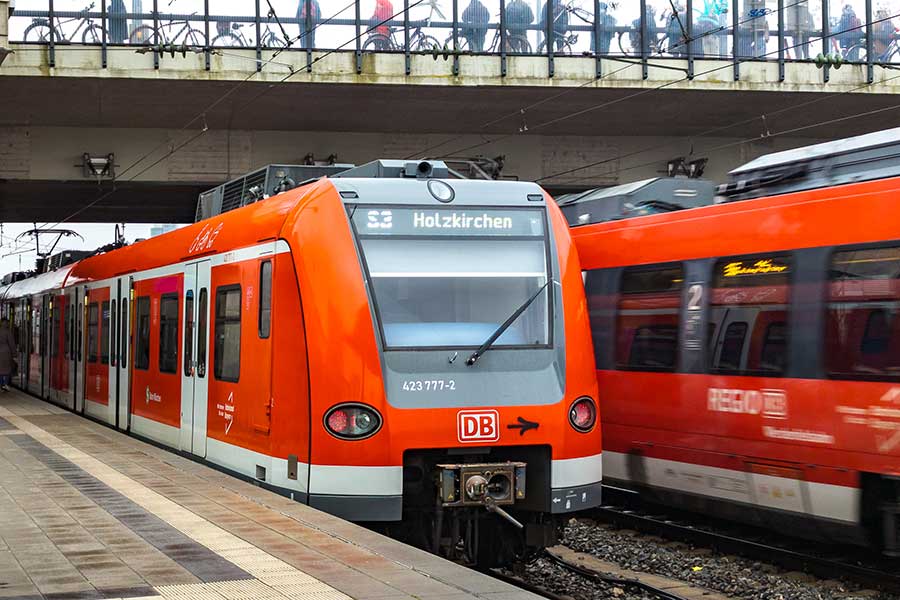
Both the Munich City Pass and the Munich Card include the option to add on a public transit pass. You can select the Inner City (Zone M) only or the Overall Area (Zone M-6). It’s important to know which is right for you.
Most visitors spending only a few days in Munich will remain in the central downtown area (Zone M). Along the central rail line, this includes Laim and Hirschgarten in the west (near Nymphenburg Palace) and past Ostbahnhof in the east. It also includes as far north as the Olympic Park and south to the zoo.
What Zone M doesn’t include is the airport (that’s in Zone 5), Dachau (Zone 1/2), and some of the lake towns (Herrsching near Kloster Andechs is Zone 3/4; Tegernsee is Zone 7; Garmisch-Partenkirchen is Zone 11).
The Overall Area option includes a much larger area. If you’re only in the city for a couple of days, you may not have enough time to explore spots farther from the city center unless you have something specific on your must-see list.
Airport Transport
The Munich Airport (known by the code MUC) is located in Zone 5. To use the pass for traveling to and from the airport, the Overall Area (Zone M-6) is needed.
Without Transport?
Both passes are available without the public transit option. This is helpful if you’re planning to explore the central part of the city on foot, prefer to pay as you go for transit, or already have a Deutschland Ticket as part of wider traveling across Germany.
Do the Math
Always do the math and consider your own situation and travel style. The add-on transit pass is the real gotcha of both options that you need to scrutinize.
A one-day Munich Card is (very) slightly cheaper to purchase without the transit pass, both for an individual and a group. Instead, purchase a one-day pass directly from MVV. However, the difference in price is small enough that it may not be worth the inconvenience of having to purchase and validate the one-day MVV pass separately.
The Munich City Pass for one, two, or three days is cheaper to purchase without the transit pass, and instead purchase a one-day MVV travel pass. (You do save a little bit with the four and five-day City Pass.)
Review your travel plans on a map and determine how much walking you’re comfortable with to see if the train pass is a necessity. Munich’s city center is relatively compact and flat. Exploring on foot and getting a feel for a city is always more fun! Download the MVGo or MVV-App, just in case you decide you want to buy a train ticket.
Which Pass Should You Buy?
For the Sightseeing Enthusiast or the Art Lover
Travelers that want to see all the sights and are spending a few days in Munich should consider the Munich City Pass. If the hop-on, hop-off sightseeing bus aligns with your itinerary (or you have a Deutschland Ticket), you can even save a bit extra by opting out on the transit pass portion of the City Pass.
For the Budget or Flexible Traveler
If your plans are more wide-open or you’re looking to keep a closer eye on your wallet, the Munich Card is a better option. It offers those discounts without the higher initial out-of-pocket cost of the Munich City Pass.
For Families
For families, both options should be considered. Ultimately, it may come down to the age of the children in the family. The City Pass has different costs for teens (15-17 years old) and children (6-14 years old); the Munich Card has a children’s rate for 6-14-year-olds.
When considering travel passes, note that as of 2026, MVV allows free travel for your own children (ages 6-14) when you purchase a single-day ticket.
Buying Your Pass & Activation
The Munich City Pass can be purchased online as can the Munich Card.
The Munich Card with transit can be purchased from MVV using their app, their website, MVG machines at U-Bahn stations, the MVG Customer Center at Marienplatz and the Central Train Station (Hauptbahnhof), S-Bahn Customer Centers at the Central Train Station (Hauptbahnhof) and East Train Station (Ostbahnhof), as well as the DB sales desk at the airport.
All cards are validated and active at the designated start time when purchased. The exception is the Munich Card purchased at MVV stations, which needs to be validated.
FAQs
Does the “1 Day” pass last for 24 hours or just the calendar day?
Both the Munich Card and Munich City Pass are validity-based, meaning they are active for the specific number of hours purchased (e.g., 24 hours, 48 hours) starting from the time you designate at purchase or validation. You don’t lose value if you activate it at 3:00 PM.
Is the Munich Airport included in the public transport option?
Only if you purchase the “Zone M-6” (Overall Area) option. The airport is located in Zone 5. If you buy the “Zone M” (Inner District) pass, you will need to buy a separate ticket to get to or from the airport.
Can I visit the same museum twice with the Munich City Pass?
No. The Munich City Pass grants free entry only once per attraction. If you want to return to a museum on a second day, you will need to pay for admission.
Do I need to print the pass?
Generally, no. If you purchase online, you can usually show the QR code on your smartphone. However, keeping a screenshot is wise in case of connectivity issues.
Are museums open every day?
This is a crucial check before you buy! Many museums in Munich (like the Pinakotheken) are closed on Mondays. If you buy a 1-day pass for a Monday, you might struggle to get full value.
The Final Verdict: Which Pass Wins?
Choosing between the Munich Card and the Munich City Pass ultimately comes down to your travel “metabolism.”
If you are a “Sightseeing Machine” determined to hit the big-ticket items like the Deutsches Museum, Nymphenburg, and the Residenz in a short window, the Munich City Pass will save you significant money and the hassle of buying tickets at every door.
However, for the “Casual Explorer” — or anyone who prefers lingering in a biergarten over rushing to the next exhibit — the Munich Card is likely your winner. It offers the flexibility to change your mind without the guilt of a sunk cost, while still knocking a few Euros off the price of admission when you do decide to visit a museum.
Whichever you choose, my biggest advice is to do the math on the public transit add-on. For many staying in the city center, skipping the transport bundle and walking (or grabbing a single-day ticket) might just be the smartest saving of all.
Save this post for later with Pinterest!

All photos and opinions are my own. This post contains affiliate links.


