
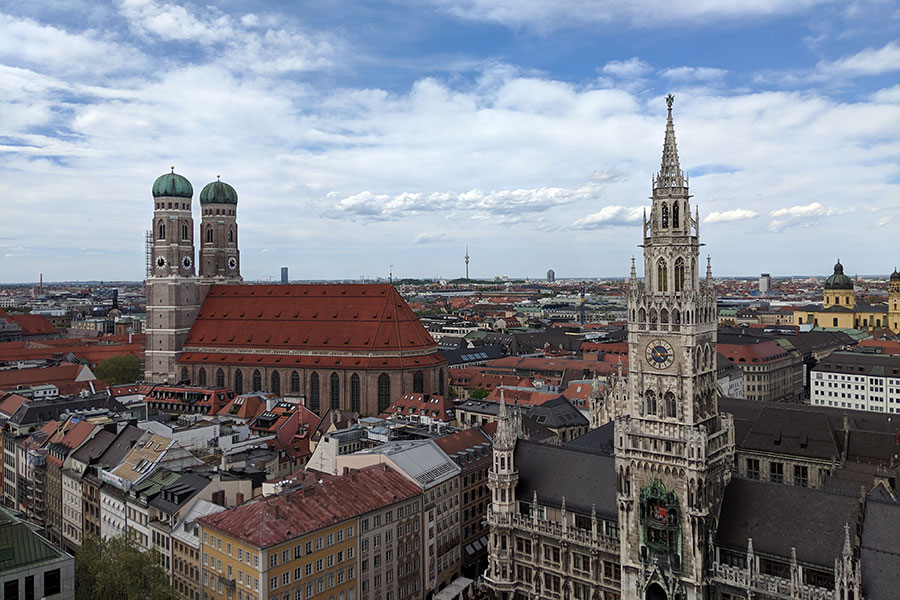
Munich is the highlight of any visit to Germany. And with its location near Neuschwanstein and the Alps, it’s a popular spot for visitors to stay and venture out on day trips. But the Bavarian capital has so much to offer, from delectable regional cuisine to world-class museums. Oh, and did I mention the beer? Stay a while and get to know the city with 3 or 4 days in Munich!
Before you start planning each day, it’s worth choosing the right neighborhood. My guide to where to stay in Munich compares the city’s best areas and hotels so you can pick the best base for this itinerary.
Table of Contents
Munich Itinerary at a Glance
| Day | Focus | Highlights |
|---|---|---|
| Day 1 | Munich’s Historic Core (Altstadt) | Marienplatz, Glockenspiel, Frauenkirche, Viktualienmarkt, Munich Residenz, English Garden |
| Day 2 | Palaces, Museums, and Local Neighborhoods | Nymphenburg Palace, Kunstareal museums, Maxvorstadt, Schwabing |
| Day 3 | Bavarian Culture and Iconic Experiences | BMW Welt, Olympic Park, Theresienwiese, Bavaria Statue, traditional beer gardens |
| Day 4 | Choose a Day Trip | Neuschwanstein Castle or Andechs Monastery and Ammersee |
How Many Days Do You Need in Munich?
For most first-time visitors, three days in Munich is the perfect amount of time. You’ll have enough time to explore the Altstadt, visit museums and palaces, enjoy Bavarian food and beer gardens, and experience different neighborhoods. If you have a fourth day, consider taking a day trip to Neuschwanstein Castle or Andechs Monastery.
Is 2 Days in Munich Enough?
As a confessed lover of Munich, my honest answer is that there’s never enough time in the city. But realistically, only a day or two in Munich isn’t enough. It does force visitors to focus on what’s most important to them and what they want to see, do, and eat. But as it’s such a large city, you end up missing out on too much.
Why 3 Days in Munich Is Ideal
With three days, time is still limited, but there’s a bit more room for variety in the itinerary. You can experience Munich beyond Marienplatz and see all the major spots while enjoying Bavarian food in a biergarten.
What to Do With 4 Days in Munich
Four days in Munich (or more!) is great because it gives you the luxury of a more relaxed pace to revisit things you enjoyed and to go a bit more off the beaten path. The extra day also allows for a day trip to Neuschwanstein or one of Bavaria’s lakes, like the Ammersee.
How to Use This Munich Itinerary
Who This Itinerary Is For
This itinerary is for first-time visitors to Munich. Maybe you’ve only been to Oktoberfest or can only make a short stop in the city. This guide will keep you focused and highlight what’s worth seeing and what’s worth skipping.
This itinerary works from almost anywhere in the city with good public transportation, but choosing the right neighborhood will make your trip much easier. If you haven’t booked accommodations yet, see my guide on where to stay in Munich.
Getting Around Munich (And Why It Can Be Confusing)
Central Munich is great for exploring on foot. The city is extremely walkable with lots of green space to enjoy. But if you’re heading outside of the city center — either for a day trip to explore palaces like Neuschwanstein and Hohenschwangau or to explore other parts in and around Munich — then public transit can be a bit confusing the first time.
For a short stay, unlimited travel passes like the Deutschland-Ticket don’t make a lot of sense financially. But tourist passes — like the Munich Pass and the Munich Card — or regional train tickets — like the Bayern Ticket — can be ideal.
Where to Base Yourself
For this itinerary, I recommend staying somewhere in or near central Munich. Neighborhoods like Altstadt-Lehel, Maxvorstadt, and Haidhausen provide easy access to the city’s major attractions and public transportation. If you’re looking for a quieter experience, Nymphenburg-Neuhausen offers a more local feel while remaining well connected to the city center.
I’ll cover specific neighborhood recommendations later in this guide.
Day 1: Munich’s Historic Core (Altstadt)
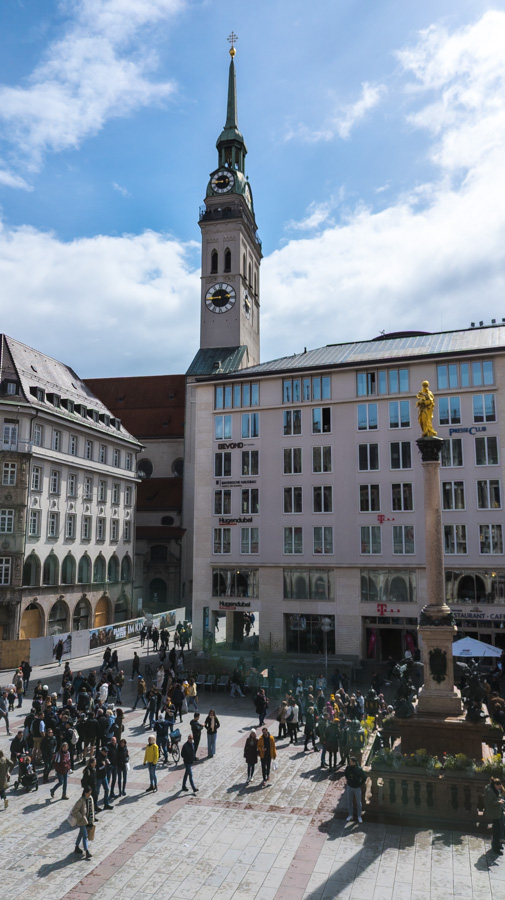
Suggested Day 1 Schedule
- Morning: Marienplatz, Glockenspiel, and Frauenkirche
- Lunch: Viktualienmarkt
- Afternoon: Munich Residenz or Asamkirche
- Evening: English Garden and dinner at a traditional beer garden
For your first day, get to know the heart of the city, its charming Altstadt, or old town. While much of the area was destroyed during World War II, the city chose to rebuild as it was before the war.
Marienplatz and the Glockenspiel
Every time I visit Munich, the first time I take the escalator out of the underground public transit hub and into Marienplatz, it takes my breath away.
The Neues Rathaus, or New Town Hall, dominates the city’s main square, Marienplatz. Just to its side is the Altes Rathaus, the Old Town Hall, which now serves as a toy museum. The Neues Rathaus was constructed in three distinct phases from the mid-19th century to the early 20th century. The Neues Rathaus observation tower offers stunning views of nearby neighbors like the Frauenkirche and Alter Peter. And, when the weather permits, you can see all the way to the Alps.
On the face of the building is the famous Glockenspiel. Several times a day, the clock performs two stories. The first celebrates the marriage of Duke Wilhelm V to Renata of Lorraine, complete with knights jousting. The second depicts the Schäfflertanz, where the dancing coopers, in their bright red jackets, spin and twirl. In the evenings, a lesser-known performance depicts the Münchener Kind (the Munich Child) saying good night.
Additionally, the Town Hall also boasts an architecturally stunning law library that is viewable on guided tours.
Plan For: 30–60 minutes
Frauenkirche
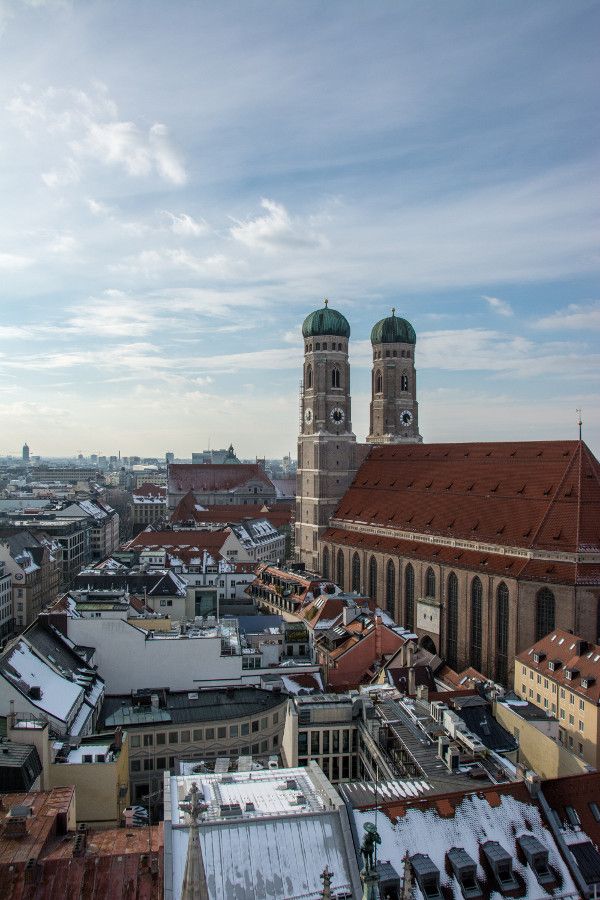
With its dual onion-domed towers, the Frauenkirche is an iconic and unmistakable sight on the Munich skyline. Completed in the 16th century but with history stretching back centuries further, the Munich church has stunning architecture and artwork. The church’s crypt is also full of notable Bavarians from the Wittelsbach dynasty, and you can find what’s said to be the Devil’s footprint at an entrance.
The church also offers 360-degree views and one of the city’s notable observation points in the building’s South Tower.
Plan For: 30–45 minutes
Viktualienmarkt
Just a few steps away from Marienplatz is the Viktualienmarkt, Munich’s open-air market that has been operating since the early 1800s. Today, it’s full of butcher shops, bakeries, and shops selling honey, garden plants, souvenirs, and more. It’s a great place to stop for lunch, whether that be a fresh Leberkässemmel or a Wurst mit Semmel. The market also has a Biergarten. The beer on tap rotates between the city’s breweries.
Plan For: 30 minutes–1 hour
Munich Residenz or Asamkirche
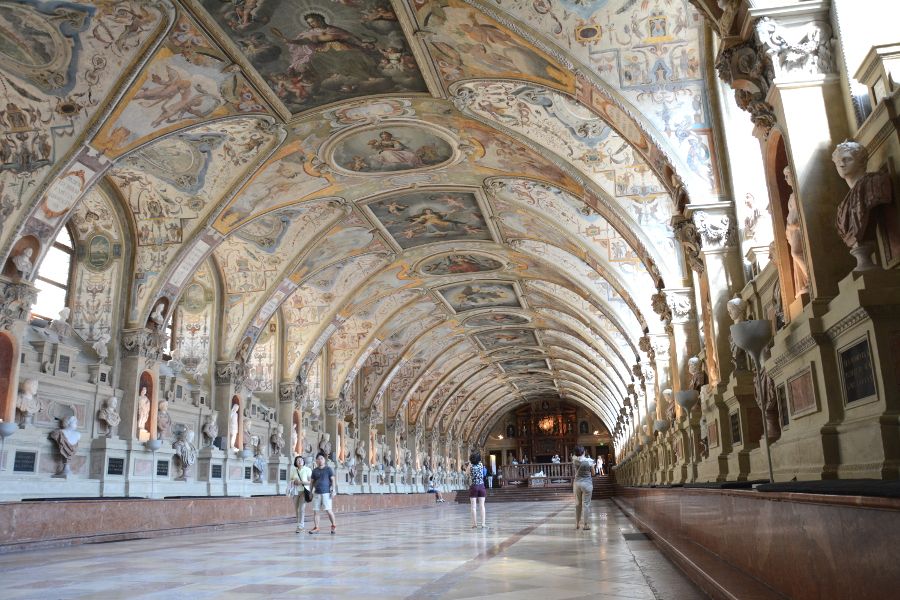
Visitors looking for historic opulence need look no further than the Munich Residenz and the Asamkirche.
You could easily spend the better part of a day exploring the Residenz, the royal palace of the Wittelsbach dynasty, the family that reigned in Bavaria for nearly 800 years. The museum includes a self-guided tour of many of the restored rooms within the palace. In the Treasury, or Schatzkammer, the Bavarian crown jewels are on display.
The Asamkirche near Sendlinger Tor offers an indulgent display of art and architecture with a shorter time investment than the Residenz. Built by two artistic brothers (Egid Quirin Asam, a sculptor, and Cosmas Damian Asam, a painter) as a private church, it was originally called the St. Johann Nepomuk Church. It eventually opened to the public and is today considered one of the most important Baroque churches in southern Germany.
Plan For: 2–4 hours for the Residenz or 15–30 minutes for the Asamkirche
English Garden and Eisbach Surfers
One place that can’t be missed on a visit to Munich is the Englischer Garten. Created in the late 18th century, it’s now one of the world’s largest urban parks. Within the more than 900 acres of the park are miles of paths to stroll while enjoying nature. The park is also home to several biergarten, including Chinesischer Turm. For a closer look at what to see, where to eat, and how to explore the park, see my complete guide to the English Garden.
Near the southern entrance to the park is the famous Eisbach, a continuous wave created on an offshoot of the Isar River. This unexpected phenomenon has turned the spot into a surfer’s paradise. It’s not unusual to spot surfers walking through the streets or cycling through the park with a surfboard under an arm.
Plan For: 1–2 hours
Where to Eat in Altstadt
There are lots of great restaurants and cafes in the Altstadt to enjoy. For traditional Bavarian cuisine, try a Wirtshaus or beer hall like Augustiner am Platzl. I recommend the bakery-café Rischart, which has locations on both Marienplatz and Viktualienmarkt.
Day 2: Palaces, Museums, and Local Neighborhoods
Suggested Day 2 Schedule
- Morning: Nymphenburg Palace and Palace Park
- Lunch: Maxvorstadt
- Afternoon: Explore the Kunstareal and visit one or two museums
- Evening: Wander Schwabing and enjoy dinner outside the tourist center
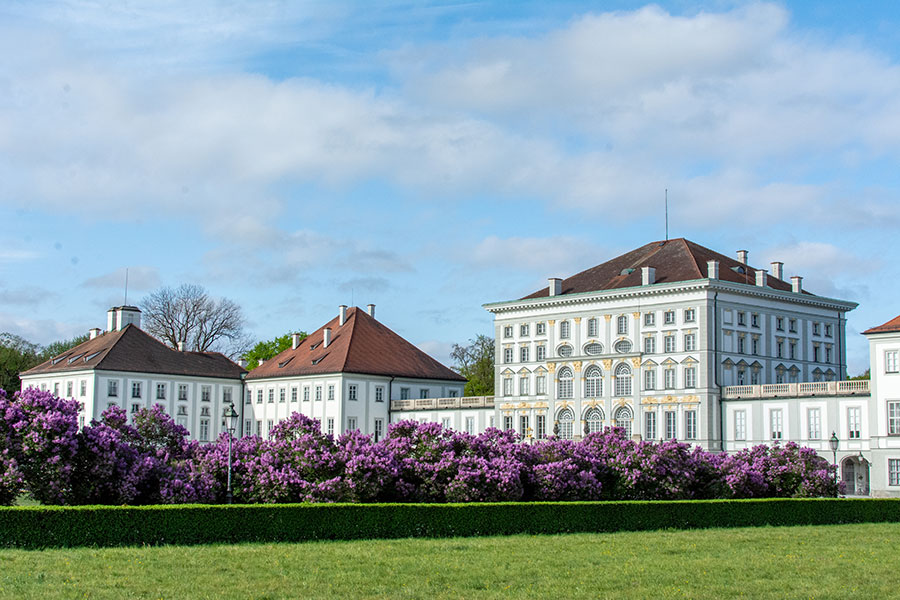
Nymphenburg Palace and Palace Grounds
Just outside of the city center sits Nymphenburg Palace, the one-time summer palace for the Wittelsbachs. The stunning palace and its nearly 500-acre park, containing a collection of small garden pavilions, are one of my favorite spots in the city. The park and palace are the perfect example of the beautiful nature that you can find in this big city.
For many tourists short on time, Nymphenburg gets skipped. But the palace and park let visitors experience a different side of Munich.
Plan For: 2–3 hours
Exploring Munich’s Museum Quarter
Munich’s Museum Quarter (or Kunstareal in German) sits in Maxvorstadt, neighboring the Altstadt. It’s home to much of the city’s culture: 18 museums and exhibition halls, more than 20 galleries, a number of universities, and more.
There are museums for every interest. There’s the Alte Pinakothek for Old Masters and artwork from the 14th through 18th centuries, and the Pinakothek der Moderne for modern works. The NS-Dokumentationszentrum München provides a critical recounting of Munich’s role and position within the history of National Socialism (the Nazi Party) in Germany.
Plan For: 2–4 hours
Wandering Maxvorstadt and Schwabing
Throughout Maxvorstadt and nearby Schwabing, you’ll find city life. And with that comes plenty of notable architecture as well as charming shops and cafes. One of my favorite shops is Kunst Oase, an antique shop hidden away off the street with so many treasures you can barely move through its countless rooms. With some patience, you can find some hidden gems, like the painting of Chinesischer Turm by a local artist that I discovered there.
Where to Eat Outside the Tourist Center
With its proximity to the universities, Maxvorstadt has lots of great restaurants in a variety of cuisines to choose from. Spots like Atzinger Wirtshaus and Alter Simpl offer modern Bavarian cuisine in a hip setting. The latter was the hangout for bohemians once upon a time in the early 1900s.
Day 3: Bavarian Culture and Iconic Experiences
Suggested Day 3 Schedule
- Morning: BMW Welt and the BMW Museum
- Lunch: Olympic Park area
- Afternoon: Explore Olympic Park and visit the Bavaria Statue at Theresienwiese
- Evening: Experience a traditional Munich beer garden
BMW Welt and the Olympic Park

Just north of the city center sits the Olympic Park, which dates to when the city hosted the 1972 Summer Olympics. Today, the complex is home to not just the park and historic buildings, but an aquarium, mini golf, theaters, and much more. It’s also a popular concert venue.
Nearby the park is the headquarters of BMW, where they also host BMW Welt and the BMW Museum. It’s worth a visit just to see the architecture of HQ: the tower is meant to mimic the four cylinders in a car.
BMW Welt is a free exhibit where the brand shows off some of its latest models. The BMW Museum lets visitors learn more about the brand and its history. The museum requires paid tickets.
If cars and automotive history aren’t your thing, substitute the BMW Museum with the Deutsches Museum, one of the world’s largest science and technology museums. If time allows, take a walk through the Isar riverfront paths or spend additional time exploring the Olympic Park’s observation points.
Plan For: 2–4 hours
Theresienwiese and the Bavaria Statue
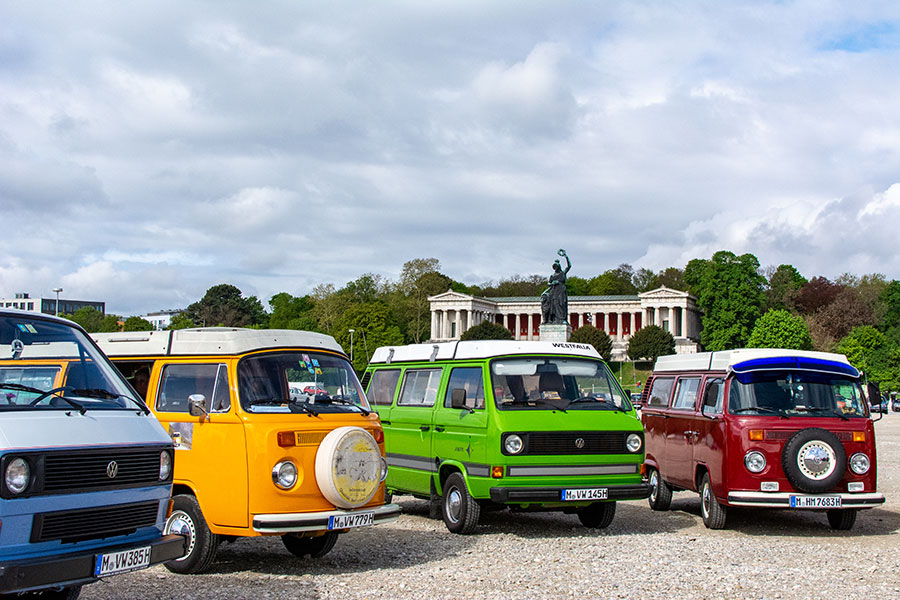
Southwest of the city center is the famous Theresienwiese, the site for Oktoberfest and countless other festivals and events. When there are no events, the Wiesn, as you’ll more likely hear it called, is essentially a park. Neighbors walk their dogs, and sports enthusiasts take advantage of its asphalt top to skate or cycle.
On the edge of the Wiesn sits the Bavaria Statue, surveying her domain. Completed in 1850, the Bavaria Statue is the personification of the Bavarian state. The statue is impressive on its own, but it has a secret! Visitors can actually go inside the statue to enjoy an observation platform in her head! While a little cramped, it’s a fun and unique experience you’ll only have in Munich.
One of my favorite things about visiting the Theresienwiese outside Oktoberfest season is seeing how locals use the space as a neighborhood park.
Plan For: 30 minutes–1 hour
Experiencing a Traditional Beer Garden
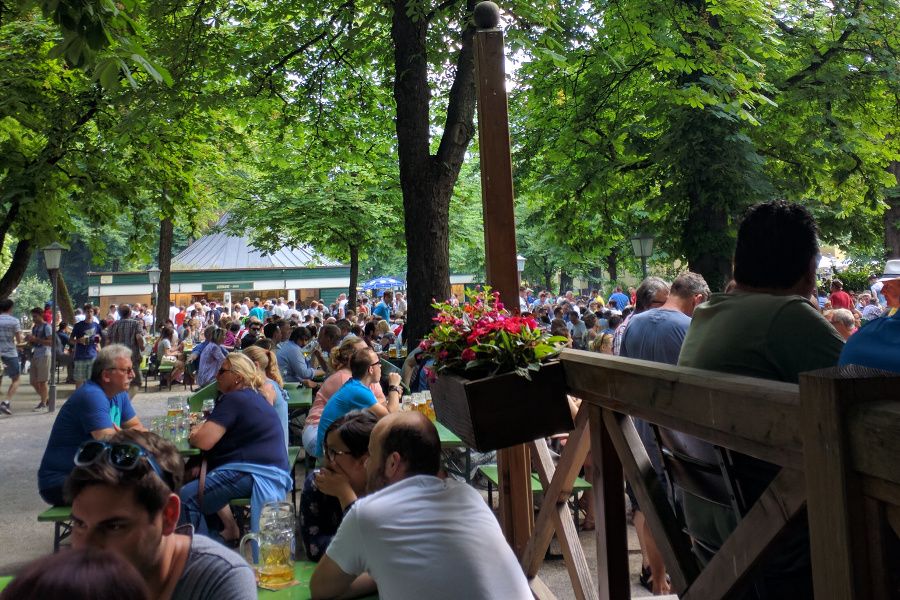
If you haven’t been enjoying traditional Munich beer gardens throughout your visit to the city, then this guide isn’t doing its job. I highly recommend visiting a Biergarten as often as you can — whether it be at a self-serve location or outdoor dining at a restaurant.
For visitors already outside the city center at the Wiesn, head a few S-Bahn stations west to enjoy Augustiner-Keller, near the Hackerbrücke stop, or Hirschgarten, near the stop of the same name. Both are large Biergartens that offer service or self-service, depending on your preference.
Day 4 Option A: Neuschwanstein Castle Day Trip
Suggested Day 4 Schedule (Option A)
- Full Day: Day trip to Neuschwanstein Castle and Hohenschwangau
- Evening: Return to Munich for a relaxed final dinner
Is Neuschwanstein Castle Worth It?
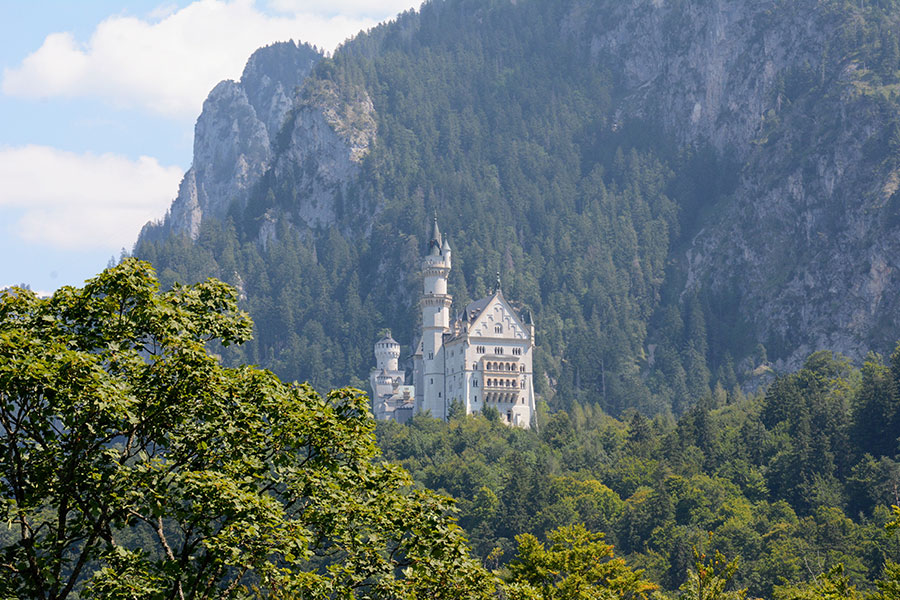
Neuschwanstein Castle is one of the world’s most instantly recognizable castles. And it’s at the top of the list of many first-time visitors to Munich. But is it worth visiting? The answer is yes, but… it depends when you’re visiting.
For visitors during the off-season, during the winter or early spring, a day trip to Neuschwanstein can be a great experience. But during the peak summer season, the crowds can be significant. Add in summer weather, and it isn’t the ideal visit.
How to Get to Neuschwanstein from Munich
To reach Neuschwanstein Castle by car, take the A7 or A95 highways to Füssen, and park in one of the four designated parking lots.
By train, take a regional train from Munich to Füssen, then a bus to Hohenschwangau village.
What to Expect (Crowds, Timing, and Tips)
- Arrive early to avoid crowds.
- Best season: Spring (April–May) offers fewer crowds and mild weather.
- Summer (June–August) is the busiest, but daylight lasts longer.
- Winter (December–February) is quieter, but some trails and viewpoints may be closed.
- Have cash on hand for parking and certain shops in Hohenschwangau Village.
Day 4 Option B: Andechs Monastery and Ammersee
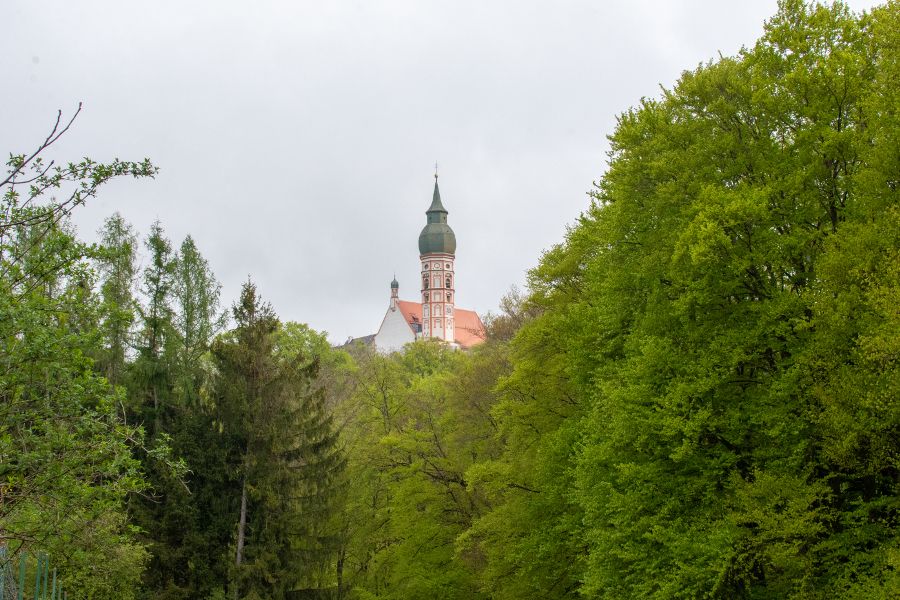
Suggested Day 4 Schedule (Option B)
- Morning: Travel to Herrsching and explore the Ammersee
- Lunch: Andechs Monastery beer garden
- Afternoon: Hike or relax around the monastery and lake
- Evening: Return to Munich
If you’ve already visited Neuschwanstein or you prefer a Munich day trip spent enjoying some of Bavaria’s charms (beer, hiking, and lakes), then heading to the city’s backyard is for you.
Why Visit Andechs Monastery
Andechs Monastery sits in the hills overlooking the Ammersee lake. The Benedictine monastery has been brewing beer since the 15th century. Today, the brewery at the monastery draws visitors from far and wide.
Andechs makes for a fantastic day trip, especially when paired with an afternoon or morning along the banks of the Ammersee in Herrsching.
How to Get to Andechs from Munich
With a car, you can drive directly to Andechs.
If you prefer to hike, you can take a two-hour route from the Herrsching S-Bahn station to the monastery. The hike can be vigorous at times, with uneven footing and steep inclines. But it’s a rewarding journey.
Combining Andechs with Ammersee
The Ammersee is a tranquil lake located just outside Munich. Taking the S-Bahn directly to Herrsching, you can stroll the country’s largest lake promenade or take the ferry to another of the lakeside towns.
Where to Stay in Munich
Munich has excellent public transportation, so you don’t have to stay in the Altstadt to enjoy the city. Whether you prefer to be close to the historic center, museums, Oktoberfest, or quieter local neighborhoods like Neuhausen-Nymphenburg, choosing the right base can make your trip much smoother.
For a full comparison of each neighborhood—including who it’s best for, hotel recommendations, and my personal recommendations, see my complete guide to where to stay in Munich.
To save some money, avoid the crowds, and experience life more like a local, I prefer to stay outside the city center in the Nymphenburg-Neuhausen area. There are some family-run hotels in the neighborhoods as well as affordable chains, like the Holiday Inn Express Munich City West.
Getting Around Munich
Munich’s public transport is great for getting around. It goes nearly everywhere a typical first-time tourist would want to go.
Understanding the U-Bahn, S-Bahn, Trams, and Buses
Munich’s public transit system consists of the U-Bahn (the subway), the S-Bahn (local trains), street trams, and buses.
How Tickets Work
Tickets for the public transit system apply to all modes of transport. For example, a day ticket can be used on any combination of U-Bahn, S-Bahn, trams, and buses.
Once you have a valid ticket, that’s it. Go travel!
In Munich and across Germany, tickets are not typically reviewed on public transit with each ride. To enforce riders using valid tickets, plainclothes officers may ask to see your ticket at any time. If you are found using public transit without a valid ticket, there is a 60 Euro fine.
How Ticket Zones Work
Another common (and confusing) part of the transit system is the zones. The transit network is defined into several fare zones. Tickets are purchased for a specific range of zones.
Most visitors only need tickets covering the M Zone. If you’re taking a day trip outside Munich, check whether a Bayern Ticket or a regional train ticket is a better value.
Final Thoughts on Spending 3 to 4 Days in Munich
Every time I return to Munich, I discover another neighborhood, museum, or beer garden worth revisiting. There’s always another day trip to explore. Munich has so much to offer to those who take the time for slow travel. And it’s why so many choose to return.
For most visitors, three days provides the perfect introduction to Munich. You’ll have time to experience the city’s historic core, museums, parks, food, and beer culture without feeling rushed. If you can add a fourth day, you’ll be rewarded with the opportunity to explore more of Bavaria through a memorable day trip. Whether it’s your first visit or your fifth, Munich is a city that always seems to offer another reason to return.
Looking to explore beyond the city? See my Bavaria Travel Guide for additional destinations including Nuremberg, Berchtesgaden, Chiemsee, and Neuschwanstein.
Save this post for later on Pinterest!
Frequently Asked Questions About Visiting Munich
Is 3 days enough in Munich?
Yes, 3 days is enough time to experience Munich’s major attractions, including the Altstadt, the Englischer Garten, museums, palaces, and traditional beer gardens. While you could easily spend longer in the city, three days provides a well-rounded introduction for most first-time visitors.
Is 4 days too much in Munich?
No, 4 days is not too much time in Munich. An additional day allows visitors to explore at a slower pace or take a day trip to destinations like Neuschwanstein Castle, Andechs Monastery, or the Ammersee.
What is the best area to stay in Munich for first-time visitors?
For first-time visitors to Munich, the best spot to stay is the Altstadt. It’s convenient and central.
Can you visit Neuschwanstein Castle as a day trip from Munich?
Yes, Neuschwanstein Castle is a popular day trip from Munich.
Is Munich walkable?
Yes! Munich is extremely walkable. But in case you decide you need to use the subway or the tram, the city also has great public transportation.
What is the best month to visit Munich?
May is one of the best months to visit Munich thanks to mild spring weather, blooming parks and gardens, and generally smaller crowds than the peak summer season. September is also popular because of Oktoberfest, while December offers Christmas markets throughout the city.
All photos and opinions are my own.


Oh I LOVE Munich. The first European city I’ve ever explored 🙂
It’s a wonderful city. The first city always holds a special place! 🙂